
 Firmy produkcyjne Kraków play an essential part in our economy and play an integral role in innovation and expansion. Firmy produkcyjne Kraków specialize in producing various goods like machinery while also offering services like IT staffing or business strategy consulting.
Lesser Poland
Lesser Poland (pronounced mawo-PO-lskie) is a province of sharp contrasts: geographically it stretches from the heights of the Tatras to hills covered with picturesque wooden churches and rural dwellings; culturally it encompasses everything from the historic beauty of ancient Kraków to the harrowing legacy of 20th-century Auschwitz.
Lesser Poland suffered greatly as a result of World War I and World War II as well as communism; only towards the end of the 20th century did Lesser Poland begin to rebuild, improving economically and becoming a popular tourist destination. It is now home to international companies such as Motorola, MAN and Delphi, as well as one of Poland’s most important business and industrial centers.
Thanks to a strong automotive industry and advanced technology, the Kraków Voivodeship can boast significant iron and steel mining operations, as well as coal extraction, with major concentrations at the Tadeusz Sendzimir Nowa Huta Steelworks and at the chemical plants in Oświęcim. Furthermore, the Kraków Technology Park and ANGRAF provide metalworking services respectively—two large enterprises that significantly contribute to the development of this industrial sector.
Food production in Italy is carried out by Italians themselves. They specialize in producing meat, fish, milk and fruit; Royal Canin is one of the leading suppliers of dog and cat nutrition; moreover, there are many smaller companies producing high-quality snacks and food products.
The voivodeship is also an attractive destination for foreign investment. Over the past five years it has attracted over PLN 4 billion in foreign investment from companies such as J. A. GASKA, Huzar, Saint-Gobain HPM Polska and ANGRAF; many projects supported under the Poland Investment Zone Program included the modernization of J. A. GASKA in Huzar, support for Saint-Gobain HPM Polska and further investments by ANGRAF; this investment will create 70 jobs.
Industry 4.0
Industry 4.0, also known as the fourth industrial revolution, is an evolutionary wave in manufacturing that connects physical and digital technologies to enable smarter factories that better respond to consumer desires. This technological convergence is driven by innovations such as automation, advanced materials and 3D printing—ultimately revolutionizing production while creating jobs throughout the economy.
This new revolution aims to connect factories and companies using technologies such as artificial intelligence (AI), big data analytics, robotics and the Internet of Things (IoT). Combined, these technologies create intelligent systems capable of controlling, monitoring and optimizing operations—not only increasing productivity but also lowering costs, improving product quality and enhancing customer satisfaction.
Implementing Industry 4.0 involves significant upfront investments; however, early adopters have reported impressive returns on this investment. A holistic approach to business and production allows manufacturers to better manage assets, streamline processes and make smarter decisions. Furthermore, IoT sensors and cloud connectivity help break down siloed departments or teams and provide access to real-time data.
Industry 4.0 offers companies another advantage by helping them achieve sustainability goals. By monitoring carbon dioxide emissions and energy consumption, companies can identify energy-saving measures that reduce their environmental impact. Effective use of big data also allows companies to manage supply chains more effectively and optimize inventory levels for maximum profit.
Industry 4.0 offers not only technological benefits but can also bring employee job satisfaction. Whereas previous industrial revolutions witnessed the mechanization of work lines and assembly lines, this fourth industrial revolution could enable workers to move away from repetitive manual tasks towards analytical work; helping workers repurpose their skills can entirely prevent layoffs.
During the COVID-19 pandemic, many companies accelerated the implementation of 4IR technologies. After six months, 94% of McKinsey survey respondents stated that these tools helped maintain operations during this pandemic, and were also essential elements of future growth plans.
Automation
Automation refers to the conversion of manual work processes into computerized systems using technologies such as robotics, machine learning and IoT integration. Automation technology can be applied in many industries to improve efficiency and accuracy while simultaneously lowering costs and increasing productivity—for example, a manufacturing company could use automated systems to more reliably replace human labor on production lines with less supervision, resulting in more productive systems with lower supervision requirements, resulting in fewer labor shortages or worker fatigue issues, resulting in cost savings and—however this type of automation comes at the expense of initial investment and employee relocation costs associated with its implementation compared to alternatives involving solely human labor.
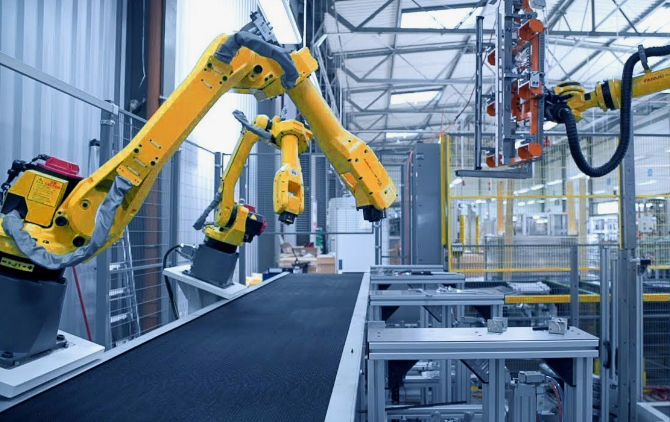
Automating devices range from simple to complex; examples of basic automation include anti-lock braking systems in cars and automatic transmissions in motor vehicles, to more complex automation such as factory and warehouse settings with industrial robots for assembly and QUALITY CONTROL functions provided by companies such as ABB or Fanuc, which can be programmed to meet production requirements. Robotic process automation (RPA), another form of automation, uses software to create robots performing human-like tasks; it is applicable in many business activities, from data entry to invoice processing.
Many manufacturers are turning to automation to achieve greater consistency, higher productivity and increased efficiency in their production processes. Automation enables manufacturers to ensure consistent product quality by eliminating errors caused by human error while improving efficiency and lowering operational costs by eliminating manual labor—for example by eliminating employee monitoring requirements, as well as the risk of fatigue or errors during manual measurements.
The future of automation looks exciting, as cutting-edge technologies such as artificial intelligence and machine learning are transforming its capabilities. Cognitive automation will enable systems to analyze unstructured data and recognize patterns; IoT integration will facilitate real-time data exchange and predictive maintenance; collaborative robots will work alongside humans for safer and more productive operations.
New technologies
In February 2024, ICE Kraków will host the inaugural show dedicated to future training technologies. As many as 50 companies will present their offerings at this modern congress center; solutions include everyday training management through physical, virtual and blended learning methods; adaptive learning tools/technologies capable of connecting with existing LMS systems with cutting-edge AR/VR solutions that enhance training effectiveness and efficiency.
The hub4industry trade show was created by experts and practitioners of new technologies to present key aspects of the future factory, the “Factory of Tomorrow.” This space gives representatives of manufacturing companies who want to add modern production elements to their facilities a chance to see these solutions first-hand.
Polish manufacturers are increasingly focusing on digitalization and automation as a way to maintain competitiveness both domestically and abroad. The development of the manufacturing industry depends on demand for advanced products such as aerospace, defense, automotive or other sectors such as aviation. For Poland to remain competitive globally, significant investments in digitalization must be made.
The Kraków Technology Park is one of Europe’s most important centers of business innovation, established through cooperation between local authorities, three of Kraków’s four universities and the business environment as well as members of the European Network of Business and Innovation Centers. Furthermore, it encourages smart specialization as well as innovative user-based approaches.